Translate this Page

Showing posts with label bacteria. Show all posts

Saturday, April 15, 2017

Death From Simple Infections: Disorders of Neutrophils

White blood cells (WBC) are made in our bone marrow and are absolutely imperative to fight infection. Without WBCs, we would succumb to even the most benign viruses and bacteria (i.e. germs) in our environment and die at a very early age. Once WBCs are made, they are released into the blood to mix with the RBCs (cells that carry oxygen) and circulate around our body. Stem cells in the bone marrow give rise to multiple WBC types, namely lymphocytes (T cells and B cells), neutrophils, basophils, eosinophils, and monocytes. Each type of WBC has a specific function. Eosinophils, for example, are important when fighting parasitic infectious. Many people are familiar with the Human Immunodeficiency virus (HIV), a disorder of T cells which impairs the body's ability to fight life-threatening bacterial and fungal infections. Neutrophils play a major function in our first line of defense against bacteria and fungi, and problems with them can carry grave consequences.


Neutrophils are typically first to the scene of an infection or traumatic injury. They are very quick, and their lifespan is only a few days. They follow chemical trails left behind by inflammation and, when they arrive, they suck bacteria into the center of their cell where some sanitizing then takes place- trapped bacteria are basically bathed in hydrogen peroxide. Two things can go wrong in this fight against the bacteria: either the neutrophils fail to work correctly, or the numbers of neutrophils are far too low to overpower invaders. Mildly low levels lead to oral/vaginal/rectal ulcers, ear infections, and skin abscesses. Severely low levels lead to overwhelming infection and death.


Disorders of the FUNCTION of neutrophils:
Congenital Leukocyte Adhesion Deficiency 1. Neutrophil movement is affected, so they are slow and fail to arrive to the scene of the infection. Newborn infants have delayed separation of their umbilical cord or infection where the cord meets the belly (omphalitis)

Chronic Granulomatous Disease. The release of the hydrogen peroxide inside the cell ("respiratory burst") doesn't work properly. Children need lifetime antibiotics (bactrim)

Hyperimmunoglobulin E Syndrome. The neutrophils don't follow the chemical trail to the site of infection like they are supposed to. Levels of an immune globulin called IgE are very high, and children have recurrent "cold" (non-red, non-tender) staph abscesses.

Chediak-Higashi Syndrome. There is a problem bringing the bacteria into the cell to sanitize them. Children also have albinism and their condition is worsened by infection with Epstein-Barr virus (EBV)


Disorders of the NUMBER of neutrophils:
External factors. Neutropenia caused by viruses (some viruses "shock" the stem cells and cause them to stop functioning for a period of time) or cancer chemotherapy

Autoimmune disorders. Neonatal Isoimmune Neutropenia occurs briefly in infants, whereby their mothers release antibodies that cross the placenta and attack their neutrophils. The disorder will resolve in less than 3 months. After 3 months, the baby can make their own antibodies against neutrophils leading to autoimmune neutropenia of infancy or chronic benign neutropenia.

Genetic syndromes. Shwachman-Diamond and Kostman Syndrome are characterized by low levels of neutrophils. Another interesting disorder is termed cyclic neutropenia, characterized by 3 day periods of neutropenia occurring every 21 days.

Tuesday, September 23, 2014

Ear Infection in Children

Ear infections are one of the most common disease processes seen by pediatricians. It is estimated that up to 85% of children suffer from at least one episode of ear infection before the age of 3.


The typical age range during which ear infections are seen is from 6 to 15 months old. Symptoms range from mild pain to hearing loss and brain abscess. There are three areas that become infected in the ear, and to understand this requires some knowledge of the anatomy:


The external or outer ear is where otitis externa (OE), also known as swimmer's ear, occurs. This is  is the only infection that causes pain with manipulation of the ear. The outer ear will usually be red and tender the the touch. The most common cause of this is a bacteria called pseudomonas, which thrives in wet conditions. The treatement for this, therefore, is over the counter ear drops that dry out the ear canal and make the area uninhabitable for the bacteria.

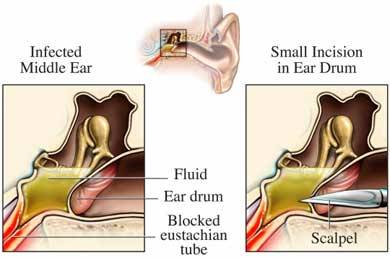
The middle ear is behind the eardrum or tympanic membrane. It is the space that houses the ear ossicles, the bones which transmit sound from the eardrum to the cochlea of the inner ear. This area is connected to the back of the nose (pharynx) via a hollow tube known as the eustachian tube.  An infection of this space is known as otitis media (OM). There are different types of OM, depending on the length of time it has persisted and whether or not fluid (effusion) is present.

Acute otitis media (AOM) typically occurs in <2 years old, usually caused by viruses such as RSV, cytomegalovirus (CMV) and Haemophilus influenzae (Hflu) but can also be due to bacteria. Mucosal congestion caused by the upper respiratory infection (URI) is aspirated up into the middle ear where inflammation occurs.
Treatment: If younger than 2 years old, an antibiotic such as amoxicillin will be prescribed. If older than 2 years old, doctors may choose to wait 48 hours to see if symptoms improve on their own before deciding to add an antibiotic. This is because studies have shown spontaneous resolution (without treatment) in up to 80% of this age group in 2-14 days.

Otitis media with effusion (OME) occurs when bacteria gets into the middle ear and fills it with pus. In growing children less than 7, the eustachian tube is often short and less vertical, so pus cannot drain properly and begins to back up. This growing pocket of fluid causes a large amount of pressure and pain to the child. The doctor will use a pneumatic otoscope to blow a burst of air at this ear drum. Normally the ear drum will move but in the case of OME, no movement occurs. Tympanometry may also be used to determine this. Long term OME (>3 episodes in 6 months or >4 episdoes in 12 months) may lead to hearing and language problems, so treatment is often indicated.
Treatment: myringotomy (hole is cut into the ear drum) with tympanostomy tube insertion is surgically performed. This allows fluid to freely drain out of the ear instead of backing up. It also alows antibiotic drops to be placed in the ear, which move through the tube and into the middle ear space to treat bacterial infections. Parents are instructed to apply the drops for 10 days whenever they see pus draining from the ears, which allows them to treat infections at home.


Reference
American Academy of Family Physicians, American Academy of Otolaryngology-Head and Neck Surgery, American Academy of Pediatrics Subcommittee on Otitis Media with Effusion. Otitis media with effusion. Pediatrics 2004; 113(5): 1412-29.

Thursday, May 29, 2014

Pediatric autoimmune neuropsychiatric disorders associated with streptococcal infection (PANDAS)


Does a simple sore throat lead to psychological symptoms such as obsessive compulsive disorder (OCD) or Tourette syndrome?
In 1998, physicians began reporting odd encephalitis (brain inflammation)-like symptoms following an infection with Group A beta-hemolytic Streptococcus (GABHS), a bacterial infection.


Currently, PANDAS is not an ICD-9 recognized disease, and there is no recommended treatment. The suggested diagnostic criteria for PANDAS is abrupt onset (or dramatic exacerbations) of OCD or tic disorder, beginning between 3yo and the start of puberty, that occurs following an infection with GABHS. The neurologic examination would reveal hyperactivity, choreiform (snake-like) movements and/or tics.

Several studies have explored this phenomenon with conflicting results. Some authors found no correlation, while others found only elevated ASO (antibody) titers or the worsening of preexisting tic or OCD disorders. While some retrospective studies verified an association between infection and these neurological changes, a direct relationship has not been established.


Many clinicians think that PANDAS is simply a misdiagnosis of Sydenham’s chorea, a criteria for acute rheumatic fever (also caused by streptococcal infection) that is characterized by spastic and purposeless movements of the face or arms. Similarly to rheumatic fever, researchers believe that PANDAS may be due to the accidental production of antibodies that attack an area of the brain known as the basal ganglia.

  •  If your child develops a sudden tic or movement disorder, or begins to display uncharacteristic psychological behavior, it is important to contact your physician. While PANDAS may be only temporary, acute rheumatic fever can lead to serious heart problems.


Reference
Pediatric autoimmune neuropsychiatric disorders associated with streptococcal infection (PANDAS). Dynamed Database. Updated February 19, 2013, Accessed May 24, 2014.


Thursday, May 8, 2014

An Update on Cat Scratch Fever


Cat Scratch Disease, also known as Cat Scratch Fever, is found in more locations than just a Ted Nugent album. This disease, first isolated in 1992, is caused by a bacteria called Bartonella henselae and affects roughly 6.6 in every 100,000 children in the United States. It's mostly benign (harmless), and in some cases goes unnoticed. Every now and then, though, a mother may see this in her child and become concerned:


The bacteria is transmitted to cats, typically kittens, by fleas. When a child is scratched by the cat, or in some cases pets the cat and then rubs his or her eye, the bacteria enters their bloodstream.

In 2-3 weeks, the child will develop lymphadenopathy, or the enlargement of the lymph nodes. The most common location of the lymphadenopathy is in the neck (33% of cases), followed by the axilla (underarm, 27%) and inguinal (groin, 18%). The child will also develop the characteristic fever and may complain of a sore throat.


In children with weak immune systems (immunocompromised), the disease may become disseminated (spread throughout the body) and cause infection of the bone (osteomyelitis), brain (encephalitis, resulting in seizures) and eye (oculoglandular conjunctivitis). In children with heart valve problems, this disease may cause endocarditis (infection of heart valve). For this reason, the CDC recommends that these children and adults avoid playing with cats or kittens, especially those with fleas.

Since the disease goes away on its own, a doctor will only need to prescribe pain medication for the painful lymph nodes. There is limited evidence that antibiotics are helpful in treating Cat Scratch Fever, so put on an old record and let Ted do all of the work.


  • Cases in adults are not uncommon. 80% of patients with cat-scratch disease are < 21 years old
  • Cases of dogs, monkeys, porcupine quills and thorns have been reported
  • The disease is not contagious. There are no reports of person-to-person transmission
  • Laboratory diagnosis is difficult, since the organism can be difficult to see. Currently, polymerase chain reaction (PCR) or Warthin-Starry Stain is used
  • Differential diagnosis of chronic lymphadenopathy includes L. venereum, mycobacteria, tularemia, brucellosis. mononucleosis, syphilis, toxoplasmosis, systemic fungal infections, sarcoidosis, lymphoma, connective tissue disease and kawasaki disease
Reference
Cat Scratch Disease. In DynaMed [database online]. EBSCO Information Services. 

Updated 2012 Oct 25. Accessed May 10, 2014.